
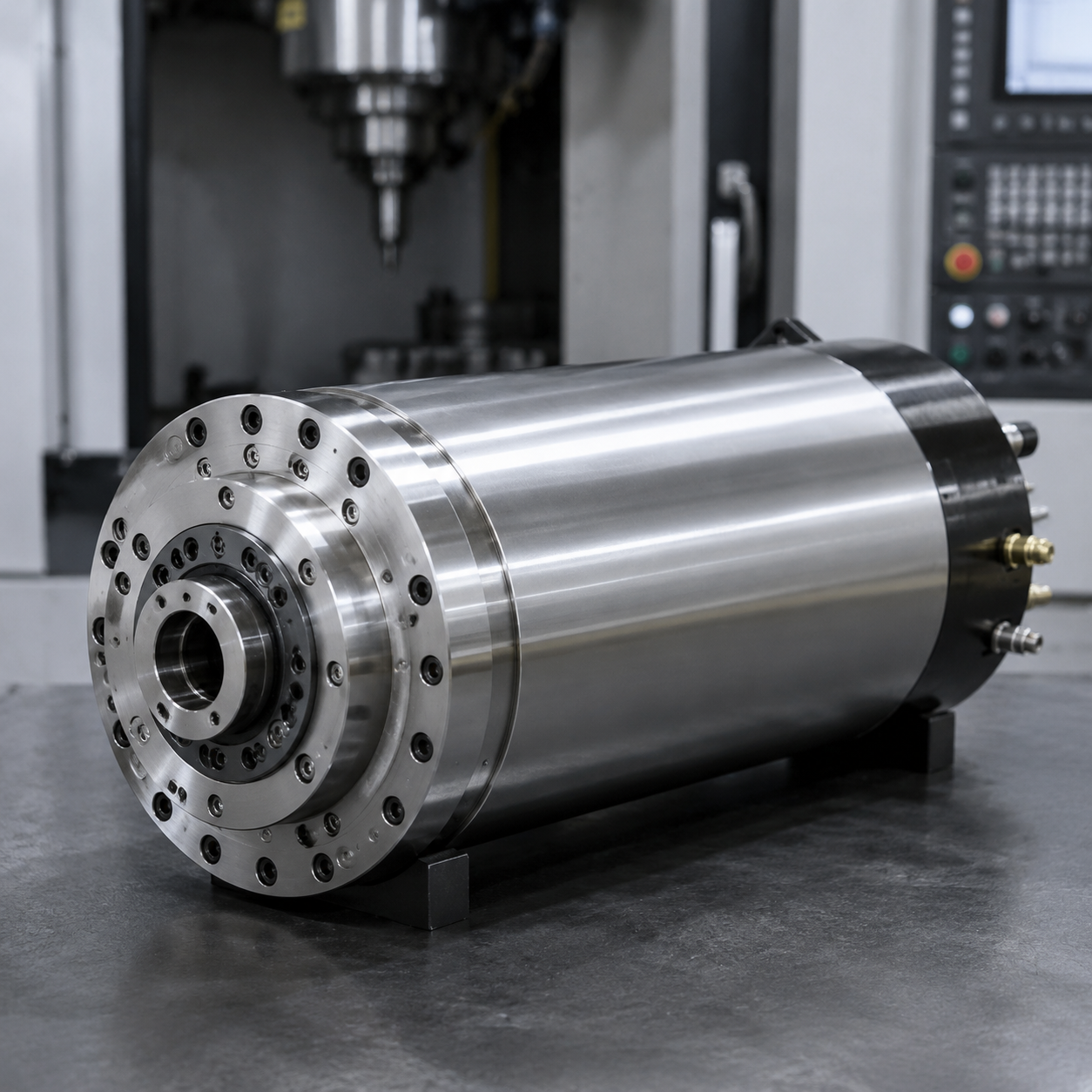
The global electric spindle market is projected to grow from an estimated $2.39 billion in 2025 to approximately $2.96 billion by 2032, representing a steady expansion driven by increasing CNC machine tool adoption, the rise of high-speed machining, and the accelerating integration of Industry 4.0 technologies across manufacturing sectors worldwide.
Market Trajectory: 2025 to 2032
The electric spindle market's growth trajectory reflects the broader expansion of precision manufacturing. The current market value of $2.39 billion (2025) is expected to reach approximately $2.96 billion by 2032, yielding a compound annual growth rate consistent with the 5-7% range observed over the past five years. This growth is not uniform across segments — high-speed spindles (>15,000 RPM) and motorized spindles with integrated drives are outpacing conventional belt-driven units, reflecting the industry's shift toward higher productivity and greater precision.
High-Speed Machining: The Primary Growth Engine
The most powerful driver of electric spindle demand is the manufacturing industry's transition to high-speed machining (HSM). HSM strategies — using small-diameter tools at elevated RPM with high feed rates — deliver faster material removal, superior surface finishes, and extended tool life compared to conventional machining. These strategies require spindles capable of sustained operation at 15,000-40,000 RPM with sufficient torque and thermal stability. As more manufacturers adopt HSM for aluminum components (automotive, aerospace), mold and die finishing, and medical device production, the installed base of high-speed electric spindles expands accordingly.
The proliferation of five-axis machining centers — which almost universally employ motorized spindles rather than belt-driven designs — further amplifies demand. Five-axis machines represented approximately 20% of new CNC machine tool sales globally in 2025, a share projected to reach 30% by 2030. Each five-axis machine requires a precision motorized spindle, often with ceramic hybrid bearings and sophisticated cooling, representing a higher unit value compared to simpler spindle configurations used in three-axis machines.
Industry 4.0 as a Structural Market Catalyst
The integration of Industry 4.0 capabilities — embedded sensing, data communication, predictive analytics — into spindle design represents a structural shift in market dynamics. Smart spindles with integrated condition monitoring capabilities command price premiums of 15-25% over equivalent non-instrumented spindles, creating a higher-value product segment. As factory digitalization accelerates, smart spindles are transitioning from niche offerings to expected specifications for new machine tool purchases, particularly among large manufacturers and automotive OEMs implementing comprehensive digital manufacturing strategies.
This trend creates opportunities for spindle manufacturers who can deliver sensor integration, data interoperability (OPC UA, MTConnect), and predictive maintenance analytics alongside mechanical spindle hardware. The value proposition shifts from selling a component to delivering an ongoing performance service — spindles that report their own health status and predict remaining service life.
Regional Growth Patterns
Asia-Pacific remains the dominant and fastest-growing region, driven by China's position as the world's largest machine tool market and the ongoing expansion of manufacturing capacity in India, Vietnam, and Indonesia. Europe maintains steady demand anchored by premium machine tool builders in Germany, Switzerland, and Italy, though volume growth is modest compared to Asia. North America shows renewed momentum from defense-related aerospace manufacturing, medical device production, and policy-driven reshoring of advanced manufacturing capacity.
Luoyang Songju: Positioned for Market Growth
Luoyang Songju is strategically positioned to serve the growing global electric spindle market. Our manufacturing base in Luoyang, China — a historic center of precision bearing technology — provides cost advantages combined with access to a deep talent pool of spindle engineers and technicians. We offer a complete range of motorized spindles from 0.5 kW to 100 kW, with speed capabilities up to 120,000 RPM, serving machine tool builders and end-users across more than 10 countries. Our commitment to ceramic bearing technology, smart spindle development, and application engineering support aligns directly with the market's growth trajectory.
The electric spindle market's growth from $2.39 billion to $2.96 billion by 2032 tells a story of expanding manufacturing sophistication. As high-speed machining, five-axis capability, and digital integration become standard rather than premium features, the spindle — always the heart of the machine tool — will continue to evolve as an intelligent, connected, and increasingly capable precision subsystem.